

The rapid growth of Artificial Intelligence (AI) has opened up a world filled with incredible possibilities but also ethical challenges. President Joe Biden’s recent Executive Order (EO) on AI is a crucial step towards creating rules that ensure AI technologies are developed and used responsibly, especially the kinds of AI that can generate new content, known as generative AI.
The EO has outlined eight main goals: setting new standards for AI safety and security, protecting privacy, advancing equity and civil rights, looking out for consumers, patients, and students, supporting workers, promoting innovation and competition, pushing US leadership in AI technologies forward, and making sure the government uses AI responsibly. These goals show a thorough approach to addressing the many concerns tied to the fast growth of AI technologies (The Verge, 2023).
A key part of this EO is the teamwork among different government agencies to create standards that prevent the misuse of AI in sensitive areas like biological materials creation, setting good practices for verifying content authenticity, and enhancing cybersecurity measures. The National Institute of Standards and Safety (NIST) is tasked with checking AI models for any issues before they are released to the public. Also, the Department of Energy and Homeland Security are to look into how AI could pose threats to infrastructure, covering risks from cybersecurity to radiological threats (The Verge, 2023).
The EO lays the groundwork for a regulatory framework that has significant implications for the Life Sciences sector, especially in the realm of working with AI. Here are four key ways it could impact outcomes in Life Sciences:
1. Promoting Responsible Bioengineering:
Several government agencies are tasked with creating standards to protect against the misuse of AI in engineering biological materials. This proactive approach can promote a safer and responsible environment for bioengineering endeavors. By setting clear guidelines, the EO helps in mitigating risks associated with AI-driven bioengineering, thus fostering a conducive landscape for ethical and responsible research in the Life Sciences domain.
2. Advancing Content Authentication:
Establishing best practices around content authentication is crucial in ensuring the credibility and accuracy of scientific data. With the rise of AI, the potential for data manipulation or misrepresentation also escalates. The EO’s emphasis on content authentication underscores the importance of verifiable and trustworthy data, which is fundamental for scientific integrity and progress in Life Sciences. This is imperative for both Life Sciences, and Public Health.
3. Enhanced Cybersecurity Measures:
The EO highlights building advanced cybersecurity programs to protect sensitive information. In Life Sciences, where vast amounts of critical research data and proprietary information are handled, robust cybersecurity measures are paramount. The EO could catalyze the development of more secure platforms and systems for data management, thus ensuring the confidentiality and integrity of scientific data and Protected health information.
4. Fostering Innovation in Pharmaceuticals:
The EO’s promotion of innovation and competition could significantly impact AI-driven drug discovery and development as well as manufacturing. The Advanced Therapies Medicinal Products (Cell, Gene and Tissue-based Therapies) space is ripe for innovation in this space as its growing adoption alongside new single-use technology has included a focus on data collection. Recent advancements in AI have the potential to accelerate the drug discovery process by analyzing large datasets to identify potential new drug candidates, predict drug responses, enhance production processes and automation. The regulatory clarity and emphasis on innovation could potentially lead to faster development of novel therapies and treatments, driving progress in addressing complex health challenges, and the growing unique needs of ATMP.
The EO’s balanced approach towards regulating AI, promoting innovation, and upholding ethical and security standards provides a solid foundation for advancing AI applications in Life Sciences. By setting clear guidelines and fostering a culture of responsibility and innovation, the EO can significantly contribute to leveraging the potential of AI to address pressing challenges in the Life Sciences sector, thus making a substantial impact on public health outcomes.
Building on earlier efforts, the EO has led to agreements between the White House and major players in the AI industry. However, it’s important to note that an EO isn’t a permanent law and lasts only through Biden’s term, emphasizing the need for lasting laws, a topic currently being discussed among lawmakers (Politico, 2023).
Industry experts see the EO as a positive step towards establishing guidelines for generative AI. Navrina Singh, founder of Credo AI, sees the EO as a strong sign of the U.S.’s commitment to handling the generative AI realm responsibly, a view that echoes the broader industry perspective (The Verge, 2023).
Workforce Implications
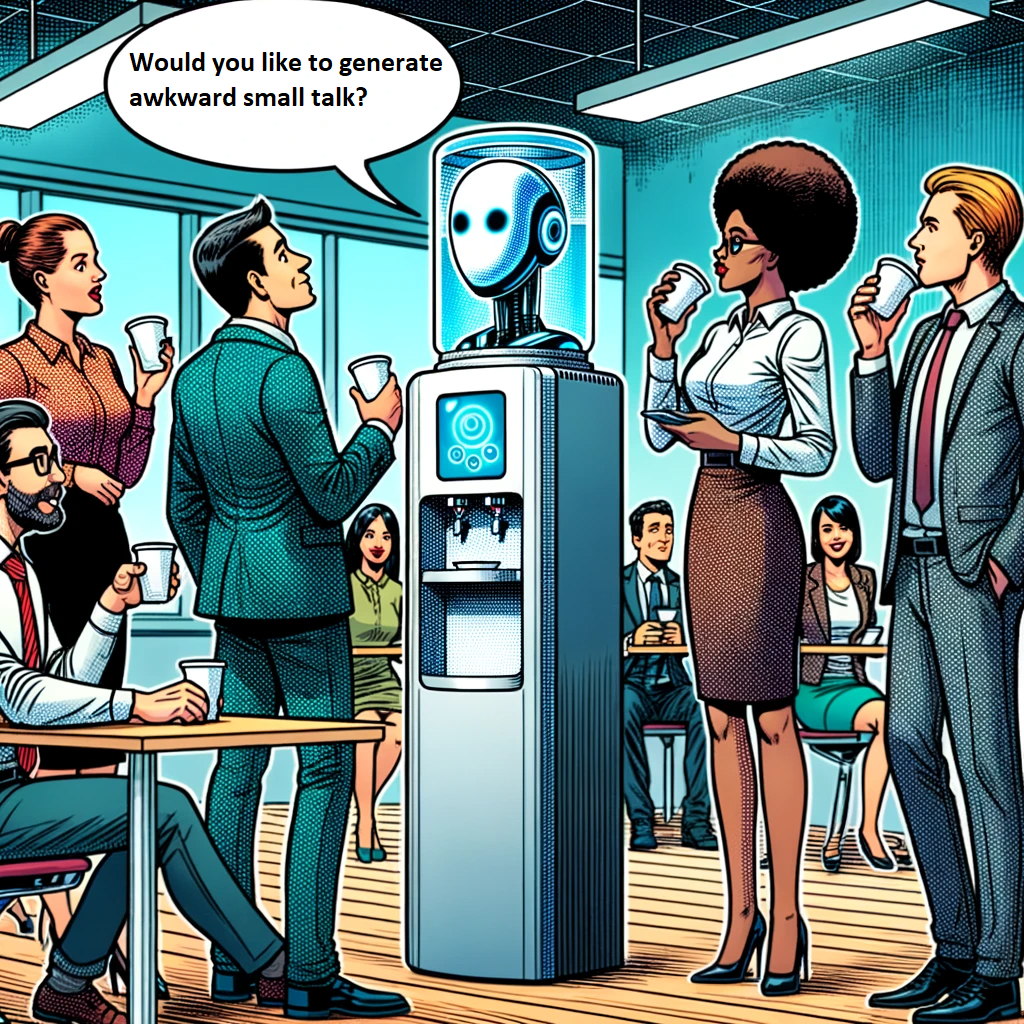
Image made with DALL-E-3
The EO addresses AI’s impact on the labor market, focusing on mitigating job displacement and promoting fair labor standards. It propels the hiring of AI professionals, streamlining immigration for skilled foreign workers to bolster the U.S. AI workforce. Furthermore, it echoes a previously published “Blueprint for an AI Bill of Rights” emphasizing protections against algorithmic bias and discrimination, crucial for fostering a fair and inclusive workplace (The White House, 2023; SHRM, 2023).
Importantly, the EO puts a focus on retaining and retraining employees: “Develop principles and best practices to mitigate the harms and maximize the benefits of AI for workers by addressing job displacement; labor standards; workplace equity, health, and safety; and data collection. These principles and best practices will benefit workers by providing guidance to prevent employers from undercompensating workers, evaluating job applications unfairly, or impinging on workers’ ability to organize.” (The White House, 2023)
It’s worth noting that Generative AI has the potential to significantly streamline processes in the biotech and life sciences sectors, akin to how machines automated manual labor during the Industrial Revolution. This transformation could lead to job redundancy, emergence of new positions, and necessitate reskilling and adaptation. In particular, AI could accelerate drug discovery, enhance precision medicine, and automate routine data analysis, necessitating professionals to upskill and adapt to AI-enabled processes, thereby capitalizing on the new roles this technology creates (Forbes Tech Council, 2023).
Importantly, the EO does not seek to pause or shutter any existing models, and these rules echo existing Policy already required of the models from the Civil Rights Act of 1964 which prohibits discrimination. From the White House Official briefing this EO: “We’re not going recall publically available models that are out there,” “Existing models are still subject to the anti-discrimination rules already in place.”
As the story of AI unfolds in real-time, each step towards creating strong rules helps steer the future towards a scenario where innovation and ethics go hand in hand. But only if those involved in the rule-making process represent people and organizations in the communities affected by the rules, so far it’s been predominantly the Tech industry.
References:
Politico. (2023). Biden to push for government standards on AI. Retrieved from https://www.politico.com/news/2023/10/12/biden-government-standards-ai-00121284
The Verge. (2023). Biden signs executive order to regulate AI ahead of legislation. Retrieved from https://www.theverge.com/2023/10/30/23914507/biden-ai-executive-order-regulation-standards
The White House. (2023, October 30). Fact Sheet: President Biden Issues Executive Order on Safe, Secure, and Trustworthy Artificial Intelligence. Retrieved from https://www.whitehouse.gov/briefing-room/statements-releases/2023/10/30/fact-sheet-president-biden-issues-executive-order-on-safe-secure-and-trustworthy-artificial-intelligence/
Forbes Tech Council. (2023, October 4). Reshaping Work: Adapting To The Future With Generative AI. Forbes. Retrieved from https://www.forbes.com/sites/forbestechcouncil/2023/10/04/reshaping-work-adapting-to-the-future-with-generative-ai/?sh=4c9c41756879
SHRM. (2023, October 30). President Biden Issues Executive Order on AI. Retrieved from
 Prompting Integration and Consulting LLC